
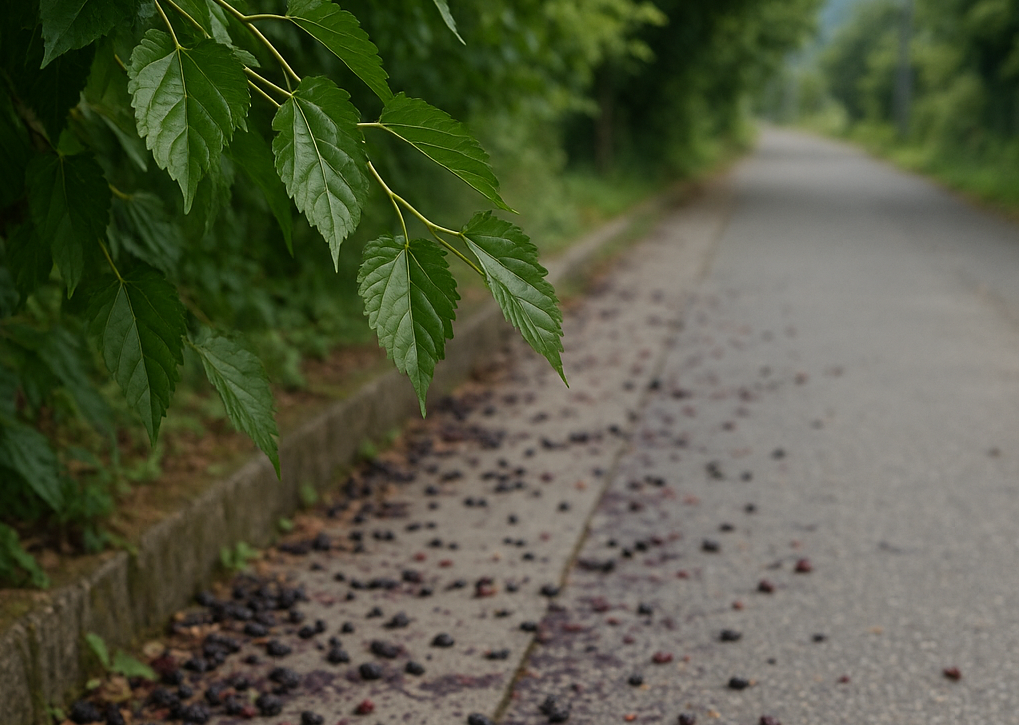
When early summer arrives in Japan, sidewalks in many old neighborhoods turn a mottled purple. The stains come from fallen mulberries—soft, sweet, and easily crushed underfoot. Few people stop to think about why these trees are there at all.
Once, the mulberry was the backbone of Japan’s silk culture. For centuries, sericulture was a vital cottage industry across rural Japan. Families tended silkworms in their homes, feeding them the fresh leaves of mulberry trees planted along fields and paths.
During the Meiji era, silk became Japan’s most important export. Regions such as Gunma, Nagano, and Yamanashi thrived on it, their wealth built on the shimmering thread that connected mountain villages to markets in Europe and America. The government encouraged scientific breeding of silkworms and the construction of reeling factories—modern temples to a national ambition of progress.
But the world changed. Synthetic fibers arrived. Global competition intensified. As Japan’s economy modernized, the patient labor of raising silkworms became less viable. By the late 20th century, the silk industry had all but disappeared, leaving behind quiet barns, abandoned reeling machines, and memories of a time when every household knew the soft rustle of feeding worms.
Yet the trees remain. Some still sprout along ditches or village lanes, descendants of those once carefully cultivated. They drop their fruit each summer, quietly marking the passing of an era. The purple stains are, in a way, the last traces of a vanished world—a reminder that even when an industry fades, nature remembers its patterns.