
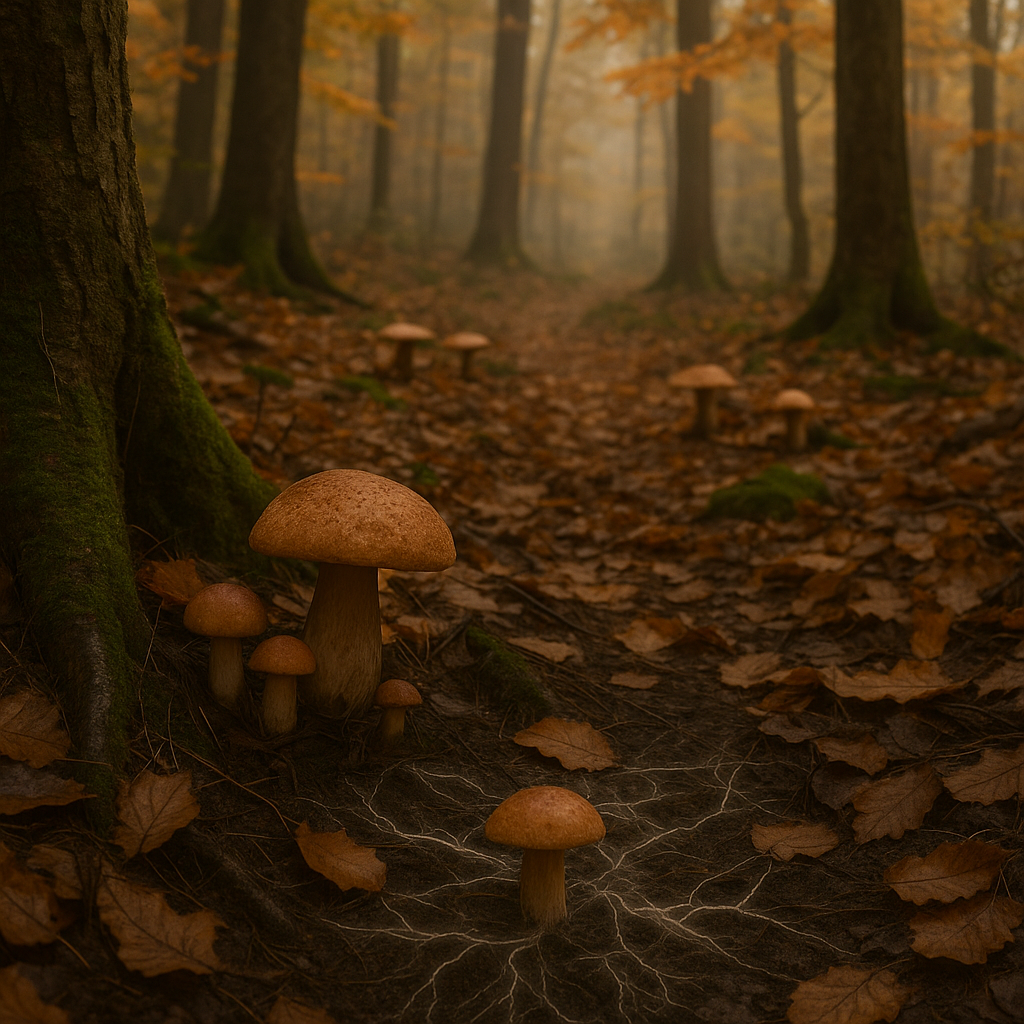
Autumn in Shinshu begins close to the ground, where the damp earth softens and mushrooms begin to rise through the fallen leaves. The scent of cedar and humus fills the air, and each morning brings small surprises—pale domes or russet caps pushing up where there was nothing the day before.
People here have long walked these wooded slopes with small knives and woven baskets, searching for the familiar shapes that emerge overnight. The prized matsutake hides beneath pine needles, its presence betrayed only by a slight bulge in the soil or a faint, spicy fragrance that experienced gatherers can sense before they see. Others—nameko, kuri-take, and shiitake—appear more freely, shining with moisture in the filtered light.
Yet what we see is only a small part of a much greater organism. Beneath the fallen leaves lies a vast network of mycelium—fine white threads that weave through roots, stones, and decaying wood. The mushrooms themselves are just the fruiting bodies, brief expressions of a hidden life that endures long after the harvest ends. This mycelial web binds the forest together: exchanging nutrients between trees, sharing signals of drought or disease, and recycling what has fallen into new life. Scientists call it the “wood wide web,” but in Shinshu’s mountains, it simply feels like the forest breathing in secret.
Japan shares this instinct for mushrooms with other great foraging cultures. Across East Asia and through much of Eastern Europe, people grow up learning to read the forest in this way—knowing which mushrooms to trust and which to leave untouched. In Japan, in China, and among Slavic peoples from Poland to Russia, mushroom gathering is an autumn ritual: part harvest, part meditation, part quiet inheritance.
In contrast, Western Europe and North America have often viewed wild mushrooms with a wary distance. Many grew up hearing that they are dangerous, mysterious, or better left alone. It is a cultural echo of older fears—of poisoning, of the untamed forest, of nature’s unpredictable generosity.
But here in Shinshu, the forest has never been so forbidding. After the rice is harvested and the air turns clear, families still venture out on weekends, children trailing behind with small baskets, learning where to look and how to kneel gently to uncover what waits beneath the leaves.
By late autumn, as the nights lengthen and frost begins to silver the undergrowth, the mushrooms vanish again, retreating to their hidden networks under the soil. The people, too, turn inward. The harvest is over, but the taste of the forest lingers—a reminder that for those who listen closely, the woods still mark the rhythm of the year.