
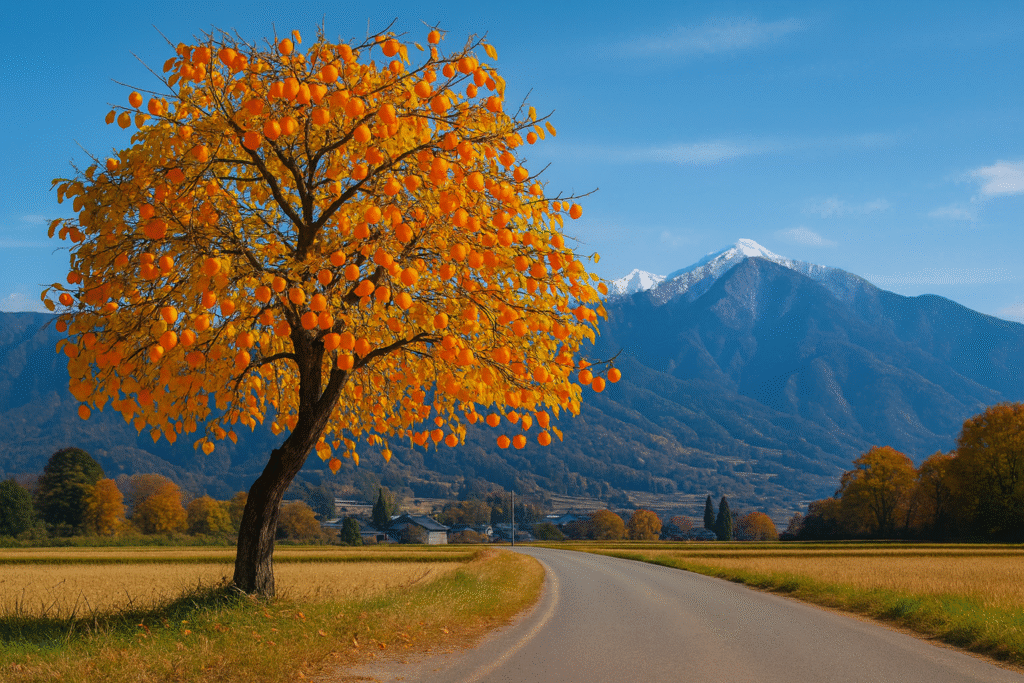
Winter in Shinshu arrives with a quiet certainty. The rice fields turn pale and dry, the mountains settle into their deep winter hues, and the chilly winds sweep the trees clean. And then—just when the landscape seems ready to slip into monochrome—you catch it on a drive between villages: a sudden flash of orange or yellow, glowing like a small lantern in the cold.
It’s the persimmon tree, standing beside a farmhouse or leaning over a field path, still holding its fruit long after its leaves have fallen. Some trees stand bare, already picked clean for the season, while others remain decorated with clusters of winter fruit.
The reason for this contrast lies in the nature of the fruit. Sweet persimmons —amagaki—, harvested early and eaten fresh, rarely remain on the tree once winter arrives. Astringent persimmons—shibugaki—are different. Hard and mouth-puckering until softened by frost or dried into hoshigaki, they often linger on the branches well into winter.
In late autumn, strands of peeled shibugaki can be seen hanging under the eaves of homes across Shinshu, turning slowly in the crisp mountain air. By winter, most families have dried what they need, and the leftover fruit remains outside, deepening in color as the season settles in.
As the cold deepens, the birds begin to take notice. Mejiro—the tiny Japanese White-eye—and the louder hiyodori, the Brown-eared Bulbul, watch these persimmons with surprising patience. For weeks, they ignore the hard fruit, waiting for the frost to soften it naturally. When that moment comes, the trees suddenly fill with life. Fruit becomes hollowed into bright orange cups. The ground beneath turns into a scatter of softened scraps. Wings flicker in and out of the branches.
It is one of the small, reliable rhythms of winter in Shinshu.
This year, the persimmons have drawn more than birds. With natural food supplies in the mountains running low, bears have been wandering unusually close to villages, following the scent of ripe or fallen fruit. In Shinshu, where persimmon trees often stand right beside houses or barns, a single neglected tree can become a nighttime attraction for a hungry bear.
Local authorities have issued warnings, and many residents have begun harvesting their trees more carefully or clearing fallen fruit. The situation is a vivid reminder of how thin the boundary truly is between the wild mountains and the lived-in valleys—and how something as ordinary as a persimmon can draw those worlds together in unexpected ways.
Persimmons hold a quiet but enduring place in the Japanese winter season and the turning of the year. Their dried form, hoshigaki, often appears among New Year’s foods, carrying the hope for sweetness, good fortune, and long life. In Shinshu, the pairing of dried persimmon with walnuts or chestnut paste adds a local touch.
The persimmon tree itself has long been regarded as a symbol of prosperity. In some households, it was customary to leave a few fruits on the branches through the New Year to invite good luck. And across Nagano, the sight of hoshigaki strings glowing under the eaves has become a beloved winter image—found in postcards, local festivals, and memories stretching back generations.
As snow begins to settle on rooftops and the valleys fall quiet, the persimmons remain—the last warm color in the slow, beautiful fade of the season. Their brightness against the bare branches gives Shinshu’s winter a gentle warmth, even on the coldest days.
And every year, when that first flash of orange appears along a quiet country road, you know the season has turned, and the quiet beauty of winter in Shinshu has begun once again.