
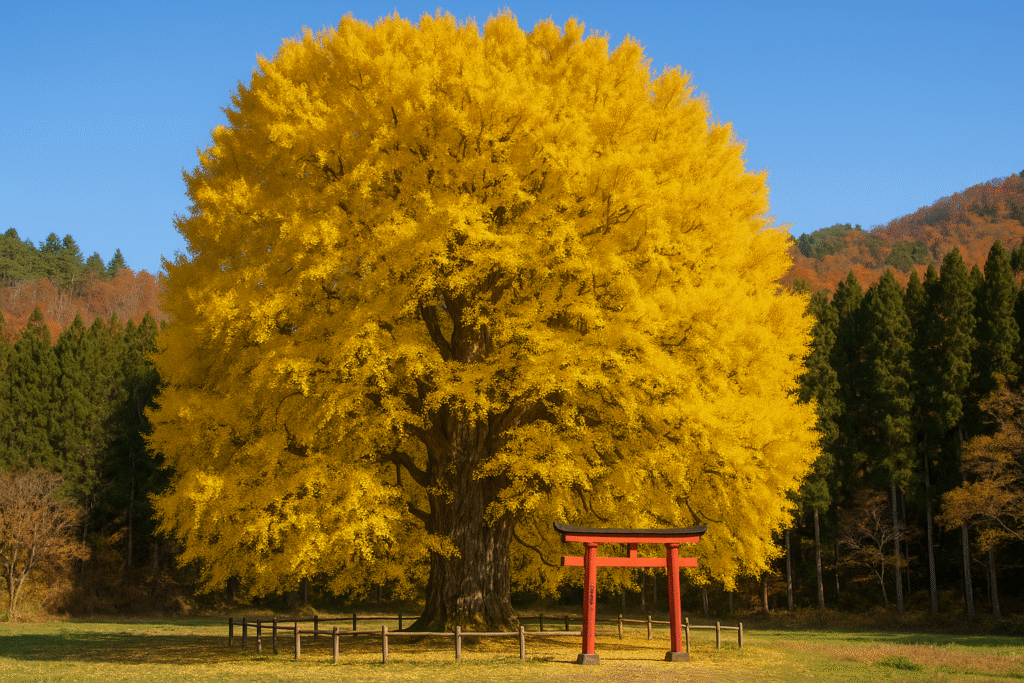
Up in the northern reaches of Nagano, where the mountains seem to fold gently around the town of Iiyama, there’s a ginkgo tree that feels as if it has always been there. The locals call it the Gōdo no Ō-ichō, and when you first see it, you understand why it has its own name. It rises quietly above the fields and farm roads, tall and steady, the kind of presence you notice even from far away. They say it’s over five hundred years old, but standing beneath it, you get the sense that it might be older still.
Iiyama is no stranger to long, snowy winters, and yet this giant ginkgo endures them without fuss. Its trunk is thick and rugged, the bark holding stories from centuries of storms and seasons. When autumn comes, the entire tree shifts into a brilliant gold, and the ground beneath it turns into a soft yellow carpet. The canopy turns into a deep, glowing gold, and on certain afternoons — the clear, crisp ones just before winter settles in — the sunlight pours through the leaves from behind. The whole crown lights up as if illuminated from within. Standing underneath it, you’re wrapped in a warm, amber world: gold above you, gold drifting down around you, gold pooled softly at your feet. It’s the kind of light that makes you forget the chill in the air.
Over time, the Gōdo no Ō-ichō also gathered its own quiet folklore. If you look closely, you’ll notice the long, pale aerial roots that hang from its branches — smooth, rounded forms that locals have long said resemble the udders of a cow. Because of this shape, expectant mothers once came to the tree to pray for an abundant supply of breast milk, leaving small offerings beneath the torii gate. The belief wasn’t loud or ceremonial; it was simply a gentle trust in the tree’s generous spirit, as if its centuries of steady growth could share a little strength with the families who stood beneath it.
What makes it even more captivating is the ginkgo’s own history. For a long time, Europeans believed the species had completely disappeared; it was known only through fossils tucked into ancient stone. Then, in the 18th century, travelers in China stumbled upon living ginkgo trees, still thriving in temple courtyards and quiet gardens. A species thought extinct turned out to be very much alive, quietly persisting across millennia.
Remembering that while standing in front of the Gōdo no Ō-ichō gives the moment a kind of gentle weight. This isn’t just a big tree in a rural corner of Nagano — it’s part of a lineage older than cities, nations, and maybe even the mountains around it. And yet it lives so simply here, shedding leaves in the autumn light, greeting each snowy winter without complaint.
Like many things in Shinshu, its beauty comes not from spectacle, but from the quiet way it keeps time. If you linger long enough, you start to feel the rhythm too.