
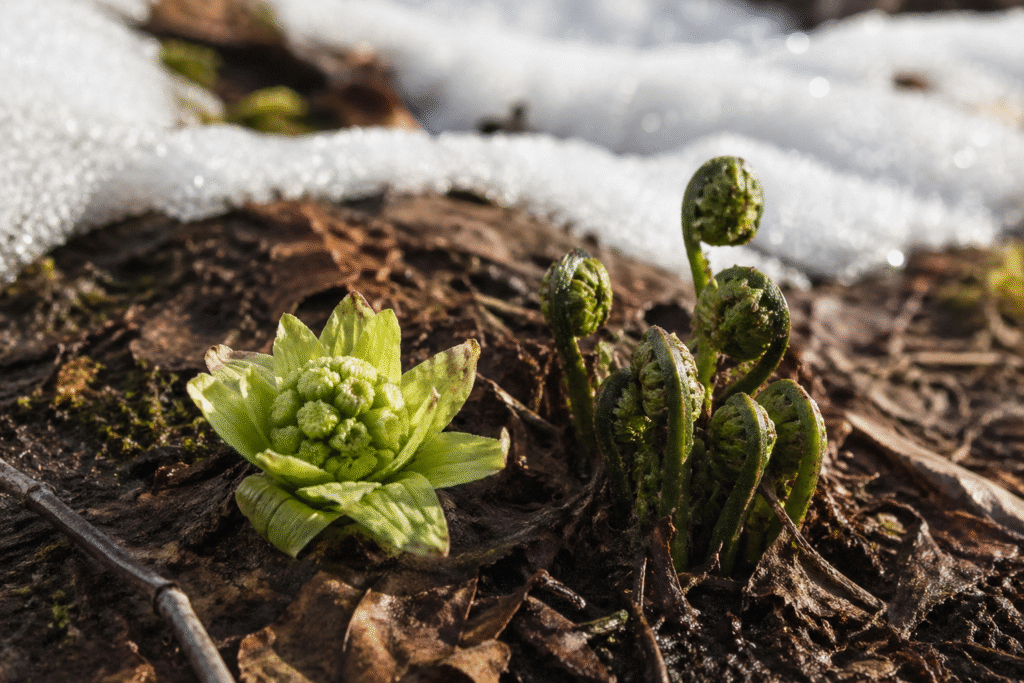
In Shinshu, the long winter begins to loosen its grip sometime in March. Snow retreats in patches, and the distant mountains take on a speckled appearance, like a Dalmatian’s black and white coat—perhaps the origin of the name Madarao Mountain, as madara means speckled in Japanese. After releasing their pollen, cedar cones shake loose and fall, tapping against my roof like a dry rain. Outside, the sound of running water is everywhere. Around this time, the clear, bell-like call of the Japanese bush warbler, uguisu, heralds the beginning of spring—and is the signal to begin foraging for mountain vegetables, sansai.
The first sansai to appear is fukinotou—butterbur sprouts—pushing up through the cold ground while traces of snow still linger nearby. They arrive suddenly, almost overnight, in familiar places if you know where to look. But their moment is brief. The tight buds quickly begin to open into flowers, and once they do, they become too strong and fibrous to eat.
This is why foraging for fukinotou requires a certain urgency. You learn to check the same spots each day, watching for that perfect stage when the buds are still compact. And when the lowlands have already passed their peak, you climb a little higher, following the slow ascent of spring up the mountainside.
Their flavor is unmistakable—intensely bitter, aromatic, and deeply satisfying. In Shinshu kitchens, they are most often prepared simply: battered and fried as tempura, or chopped and mixed with miso to make fukinotou miso. The bitterness lingers, but in a way that feels cleansing, as if the body itself is waking up after winter.
Not long after, another sign of spring begins to unfurl. kogomi—ostrich fern fiddleheads—emerge in bright green coils from the forest floor. Where fukinotou is sharp and bracing, kogomi is gentle. Their flavor is mild, slightly nutty, and easy to welcome.
But here too, timing is everything. The tight curls soon open into full fern fronds, and with that, their tenderness is lost. As before, you move quickly—or move upward.
Boiled lightly and dressed with soy sauce or sesame, or prepared as delicate tempura, kogomi marks a shift in the season. The bitterness of early spring gives way to something softer, greener, and more forgiving.
Together, fukinotou and kogomi trace the arc of spring—not as a single moment, but as something you follow, step by step, up the mountain. Each stage passes quickly, leaving only the memory of its taste.